
Making a Killing
Notes from a stoat's breakfast, and the blurry end of a leveret's life...

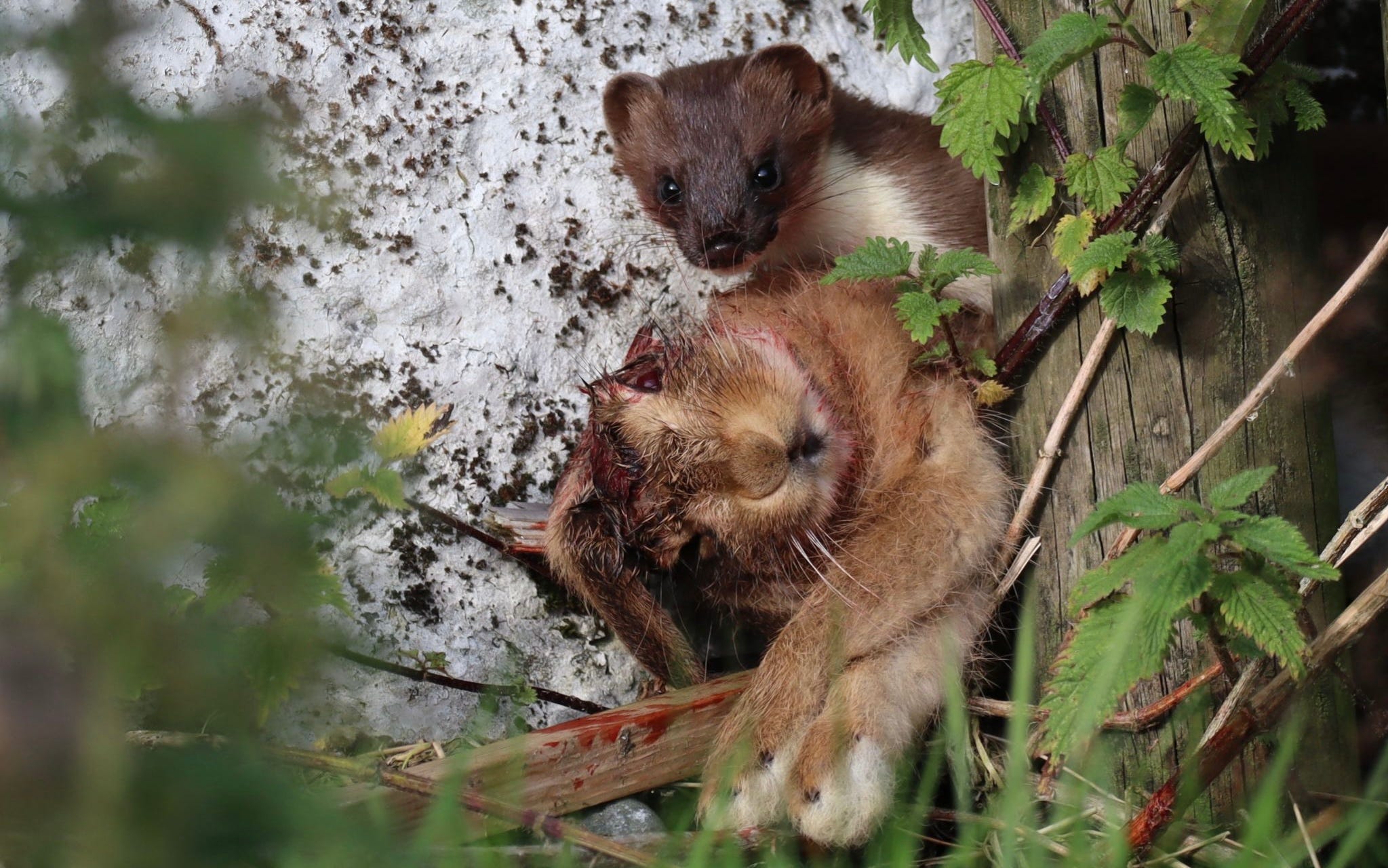
A leveret lived in the yard beneath my trailer. I watched it grow from the size and shape of an apple, gathering weight and wariness during the dry weeks of early July. I have no evidence to suggest it was one sex or another, and since hares have often been held to switch between male and female, this ambiguity was apt. But where pronouns are needed in nature, hares are frequently called female – and I can’t explain why I reckoned that this one was male. And by the time he was killed, I might have mistaken his size for an adult rabbit. People get confused by the difference between males and females and hares and rabbits, and it feels important to tell them apart. But stoats don’t care.
Death came in broad daylight, but the precise moment this leveret ceased to live was blurred by a pattern of decline and resurrection which took place over thirty minutes. There was a period when he was still able to walk – and this he did thoughtfully, carrying his killer on the saddle of his back. When that ability was lost, he lay in a kind of form as if he was trying to sleep – but instead of twitching to the magic of wondrous dreams, his head jerked because pipes and cables were being torn from the source of his brain. His eyes narrowed. One of them filled with blood until it was dark and bulbous as an over-ripe cranberry.
Stoats know how to kill effectively, but this one was mad with excitement. Most of her work was directed towards the weak juncture between the leveret’s skull and the first vertebra, but sometimes she would break away to slash at the belly or one of his legs. A young hare’s skin is no thicker than a dove’s; late in the struggle, streaks of meat and muscle had been exposed by the stoat’s ripwork. The skin of his shins bunched around his ankles in wrinkles like a schoolboy’s socks, and then he lay at last on his side and was dragged, still gasping, towards a forest of nettles.
This work is both triumph and hazard for the stoat. It’s loud and spectacular, and there are many other creatures hunting the same landscape. In the fury of killing, a stoat not only risks being robbed of a well-caught meal – she might easily be caught and killed herself. Predation calls for a blend of vigilance and violence, and you might imagine that this hunter would’ve held those two concerns in balance. But stoats are too wholehearted to think of more than one thing at a time, and she gave herself entirely to each preoccupation in clearly demarcated shifts.
In a blaze of obviousness, she would defile the hare with every grand expression of frenzy – fur would fly for thirty seconds, then she would abruptly stop and bounce apart from the mess she’d made. She’d freeze and look around herself in a state of hypervigilance, as if it were possible to inhale so much of the world in a single second that it would not be necessary to look again for a minute.
By moving only when she was killing, I was able to crawl towards the creatures in that diminishing slide towards the end. There were times when I could have touched them with a byre brush, but I lost sight of the pair as the show moved slowly down into deeper cover. Nettles quaked and stems of sow thistle trembled ominously above the wreckage as the leveret’s ragged breathing grew softer and was overlapped by the spongy sound of chewing.
[First published on Bog Myrtle and Peat; July 2023]