
Beachcomber's Delight
What would you do with a dolphin's skull on the edge of the world?

When you stand on the sands and look west from Islay’s Machir Bay, you’re facing out towards an oblivion of seascape. There’s nothing between yourself and Newfoundland – it’s just water heaving in a relentless mess of currents and moods and it’s slightly frightening in the same way as when the sky leans overhead as you climb on a ladder. The same feeling applies just as readily on Islay as it does in Galway, Cornwall, Brittany and Galicia – the sense of space is incomprehensibly vast, and yet here’s the edge of it, nudging at the soles of your feet.
Endless tides and heavy winter winds blow all kinds of junk onto Machir Bay. Some of it seems designed to heighten that sense of mighty distance, and it’s not uncommon to find lobster tags registered to fishermen in Maine and Canada. There is always talk of “sea beans” which have washed across the Atlantic from the Caribbean, and while these are certainly found on Islay, their symbolism and enormity far outweighs the literal objects themselves. From what I hear, they’re just ignominious blobs, more like wooden turds than mystical messengers from a New World.
And beyond what can be readily identified as far-travelled, the majority of what lies on the beach at Machir Bay is entirely anonymous. Massive dumps of kelp and weed lie at either ends of the beach mouth, speckled with flecks of foam like the stuff old people get in the corners of their lips. It looks like it’s been dredged up from some impossible depth, but it’s impossible to say because the stuff that grows at the bottom of the deepest trench looks just the same as that which tickles your toes in the shallow end of a kiddie’s rockpool. It might have travelled a thousand miles to Machir Bay - or it might have come from sixty feet away.
But there are also a thousand exciting details in the mass and confusion of variety scattered across this beach. In a two hour search, I found dead birds and beautiful shells; funny rocks and perfectly serviceable wooden boxes – and who knows where they came from. Beneath mats of reeds and rushes and screeds of disgustingly fragmented plastic nurdles, I found a collage of feathers and a veritable salad bar of seaweeds in every colour, shape and texture imaginable. And tending towards the mindset of a hoarder, I couldn’t resist gathering some of this pretty, confusing junk in the pocket of my coat.
And now I have time to analyse my treasure trove, I find that I am the proud owner of:
An immaculate female eider duck’s feather
Seventeen golden periwinkle shells which, when wet, look just like freshly buttered sweetcorn kernels.
A fragment of mother-of-pearl that is indescribably pink on one side.
The skull of a razorbill, complete with its gloriously decorated razor bill.
The corpse of a Great Northern Diver (from which the skull was extracted and cleaned so that it can be compared with the skull of a razorbill).
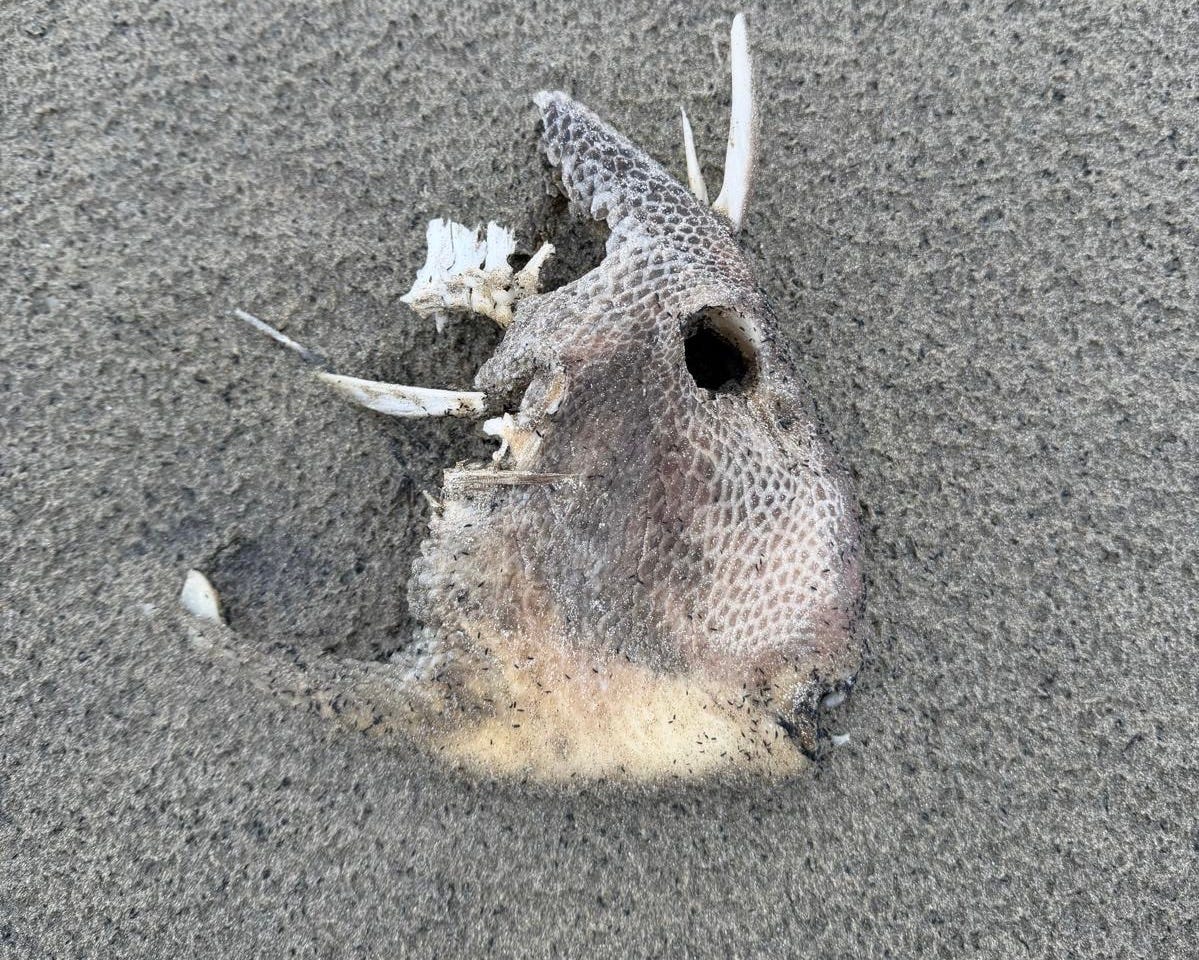
But we never regret the things we have – only those we left behind. And now my knuckles tighten with frustration to remember that there was a dead triggerfish lying half-buried in that sand – a very long way from its warmer, southern home. It’s a fascinatingly unusual find; ugly and buck-toothed in a paperwork of peeling scales – and while I can’t exactly explain what I might’ve done with the rotten body of a fish, it feels painful now to remember that I didn’t bring it home. I could’ve decided what to do with it afterwards.
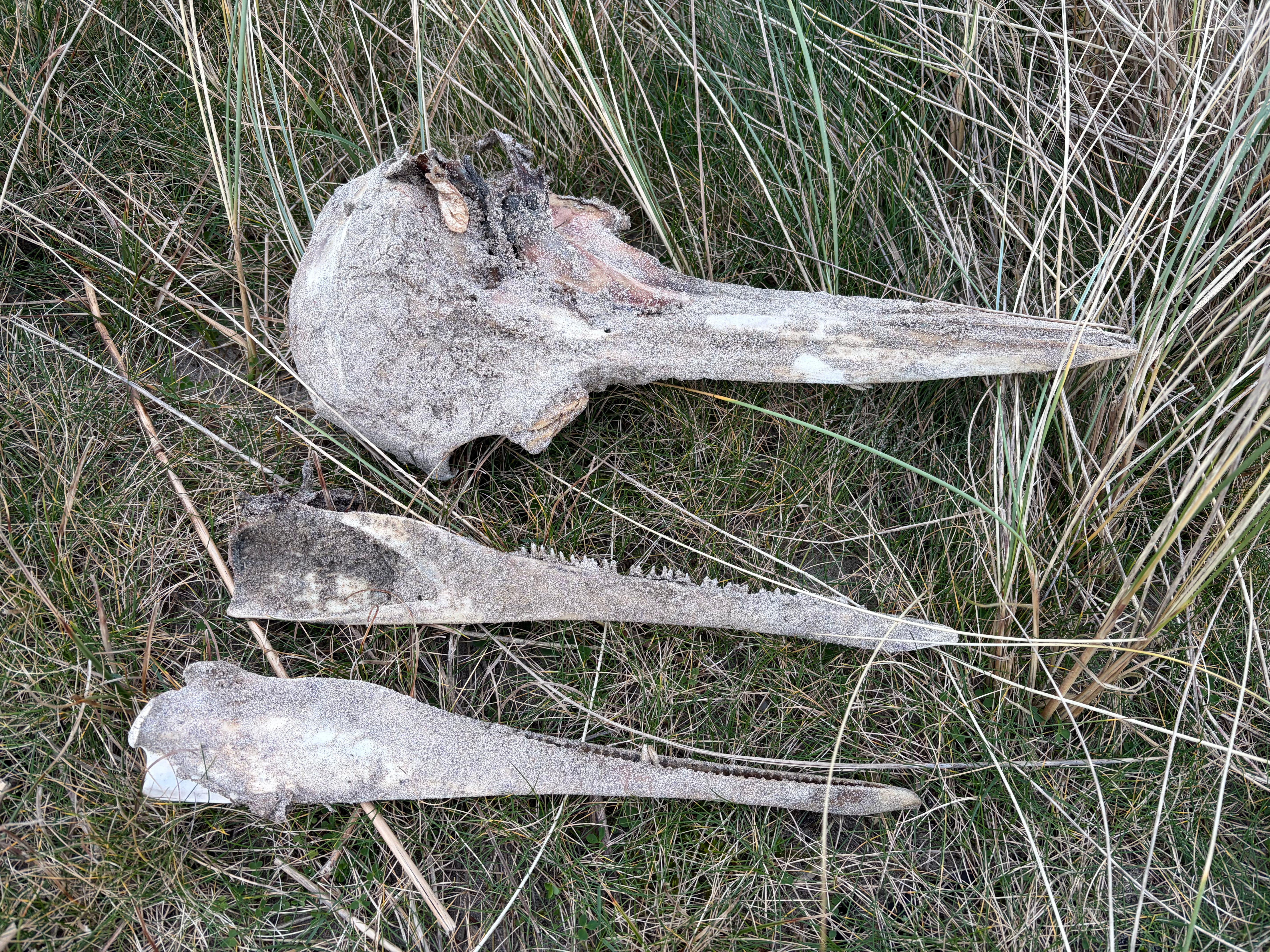
And worse still, I also discovered a long-dead bottlenose dolphin on that beach. Its bones were scattered like the pieces of a boardgame through the dunes, and I followed the trail of vertebra until I finally discovered the complete skull and jaws, half buried in a foot of sand. That burial had preserved a fair measure of meat on the bone, and of course it was utterly foetid and dripping with maggots which had themselves died and been half-eaten by other maggots.
I am desperately proud of a porpoise skull I pulled out of the Solway ten years ago – but this head was twice the size and it also had the accompanying jaws in place. I was ready to endure the terrible smell of that dolphin on the long drive home for the sake of comparing and contrasting the two skulls, but even as I started to work out how I would wrap it up and carry it back to the car, the serried ranks of tiny, delicate teeth began to fall out of their sockets and down into the sand. There were just too many of them, and as they tumbled out of the skull, I immediately lost track of which one had been where. Bottlenose dolphins have around 100 teeth, and even the ones I could find again were desperately fiddly little things with hollow roots. In no time at all, the skull was looking decidedly gummy – and the appeal of this monstrous head was further reduced by a thin stream of shockingly rancid gel which had begun to trickle out of the hole where the spinal column used to be.
I am a fairly determined gatherer of natural curiosities, but even I could not deal with that. So taking the white, dry and patchily toothed lower jaws as a relatively odour-free compromise to show my son, I reburied that skull in the sand where I had found it. And no matter how much I washed my hands that night, the smell continued to follow me around.